SodaSlim Official Website › Choosing a metabolism supplement
Choosing a metabolism supplementChoosing A Metabolism Supplement: A Method, Not A Recommendation
Read the amounts first, and read the price per day second.
Everything else on a supplement label is secondary to those two numbers. This guide sets out how to read a panel, what a proprietary blend hides, which quality marks certify something and which certify a procedure, and the six questions worth answering before paying.
Written as a method so it works on any product in this aisle, including the one this website sells and including the ones it does not.
Step one: find the amounts
Turn the bottle over and look for a Supplement Facts panel. It is a legal format: serving size, servings per container, then each ingredient with an amount per serving and a percentage daily value where one exists.
Three things can happen. The panel prints an amount against every ingredient, which is the best case and lets you compare each one with the trials. The panel prints a proprietary blend with a single total, which tells you the sum of several ingredients and nothing about the split. Or there is no panel at all, which means no comparison with any trial is possible.
A blend total is worth more than nothing. If a blend of five botanicals totals 300 mg, no single one of them can be at a researched dose of 1,500 mg, and the arithmetic settles the question without anybody having to argue it.
Step two: compare each amount with a trial
Take the two or three ingredients the product leads with and look up what the published trials used. The doses on the category guide are a starting point and every one of them carries a citation.
Three outcomes are worth recognising. The label amount is at or near the trial dose, which is the case where the research is at least relevant. The label amount is a fraction of it, which is common and means the trial does not transfer. Or the label amount is higher, which is not automatically better and is worth a second look at the safety literature.
A fourth outcome is that the ingredient has no human trial at all. Raspberry ketone is the standing example in this category: an ingredient with a reputation built on mice, present on a great many labels.
Step three: count the stimulants
This is the safety step and it is the one most often skipped. Work out how much caffeine a day the product contributes, add the coffee, tea, cola and energy drinks you already have, and compare the total against the 400 mg figure the 2018 caffeine safety review settled on for healthy adults.
Caffeine hides under several names on a label: caffeine anhydrous, green tea extract, guarana, green coffee bean, yerba mate, kola nut. A product can carry three of those and print no total.
Where the amount is not printed at all, the arithmetic cannot be done, and the workable substitute is behavioural: take the first dose on a day with no other caffeine in it and judge from what you feel.
Step four: read the marks properly
| Mark | What it certifies | What it does not |
|---|---|---|
| GMP certified | That the facility's procedures were audited | Anything about what is in your capsule |
| FDA-registered facility | That the agency has the address on file | Approval, inspection or testing of any kind |
| Non-GMO | A sourcing declaration about the inputs | Purity, potency or identity |
| Made in USA | Where the capsule was assembled | Where the ingredients came from, unless it says |
| Third-party tested | Potentially a great deal, if a certificate exists | Anything at all, if no certificate is published |
| Doctor formulated or developed | Nothing, unless a clinician is named | Clinical review, efficacy or safety |
The distinction worth carrying away is between process marks and product testing. Most marks in this aisle are the first kind.
Step five: price it per day
Per bottle is the number sellers print and per day is the number that compares. Divide the pack total by the days it covers at the label dose, and two products stop being comparable on sticker price alone.
Two traps live in that arithmetic. A sixty-count bottle at a two-capsule serving is thirty days, not sixty, and it is priced against a thirty-count bottle at one a day. And a free-shipping threshold can make a larger pack cheaper in absolute terms than the step in sticker price suggests.
Then compare the per-day figure against what the product is realistically buying you. A few per cent of daily energy expenditure at two and a half dollars a day is a decision worth making deliberately.
Step six: read the guarantee before the label
It sounds backwards and it is not. A guarantee decides what a mistake costs, and in a category where most products do something small, being able to stop cheaply is worth more than most of the claims on the front panel.
Three details decide whether a window is real. Whether it runs from purchase or from delivery, which can be a week of difference. Whether opened bottles are included, because a window that requires an unopened bottle is a returns policy rather than a guarantee. And who pays return postage, which is almost always the buyer.
Then check whether the pack you are buying fits inside it. A six-month supply against a sixty-day window means four months you cannot return, whatever the per-bottle price says.
The six questions, in one list
- Are the amounts printed? If not, no trial comparison is possible and you are buying a list of names.
- How do the amounts compare with the trials? At the dose, a fraction of it, above it, or an ingredient with no human trial at all.
- How much stimulant is in it, and in my day already? Against 400 mg for a healthy adult, and remembering that caffeine hides under several names.
- What do the marks actually certify? Process, or product. Almost all of them are process.
- What does it cost per day? Not per bottle, and counting days rather than capsules.
- What does a mistake cost? The window, where it starts, whether opened bottles count, and whether the pack fits inside it.
The first. Everything else is a refinement of it. A label that prints its amounts can be checked against the published literature by anybody with an afternoon; a label that does not can only be taken on trust, however good the rest of the packaging looks.
Who publishes this SodaSlim website?
The sources this method draws on.
- Doepker C, Franke K, Myers E, Goldberger JJ, Lieberman HR, O'Brien C, et al. Key Findings and Implications of a Recent Systematic Review of the Potential Adverse Effects of Caffeine Consumption in Healthy Adults, Pregnant Women, Adolescents, and Children. Nutrients. 2018;10(10):1536. PMID 30340340. https://pubmed.ncbi.nlm.nih.gov/30340340/
- Noordzij M, Uiterwaal CS, Arends LR, Kok FJ, Grobbee DE, Geleijnse JM. Blood pressure response to chronic intake of coffee and caffeine: a meta-analysis of randomized controlled trials. J Hypertens. 2005;23(5):921-8. PMID 15834273. https://pubmed.ncbi.nlm.nih.gov/15834273/
- Oketch-Rabah HA, Roe AL, Rider CV, Bonkovsky HL, Giancaspro GI, Navarro V, et al. United States Pharmacopeia (USP) comprehensive review of the hepatotoxicity of green tea extracts. Toxicol Rep. 2020;7:386-402. PMID 32140423. https://pubmed.ncbi.nlm.nih.gov/32140423/
- Jurgens TM, Whelan AM, Killian L, Doucette S, Kirk S, Foy E. Green tea for weight loss and weight maintenance in overweight or obese adults. Cochrane Database Syst Rev. 2012;12(12):CD008650. PMID 23235664. https://pubmed.ncbi.nlm.nih.gov/23235664/
- Heymsfield SB, Allison DB, Vasselli JR, Pietrobelli A, Greenfield D, Nunez C. Garcinia cambogia (hydroxycitric acid) as a potential antiobesity agent: a randomized controlled trial. JAMA. 1998;280(18):1596-600. PMID 9820262. https://pubmed.ncbi.nlm.nih.gov/9820262/
- Morimoto C, Satoh Y, Hara M, Inoue S, Tsujita T, Okuda H. Anti-obese action of raspberry ketone. Life Sci. 2005;77(2):194-204. PMID 15862604. https://pubmed.ncbi.nlm.nih.gov/15862604/
- Vinson JA, Burnham BR, Nagendran MV. Randomized, double-blind, placebo-controlled, linear dose, crossover study to evaluate the efficacy and safety of a green coffee bean extract in overweight subjects. Diabetes Metab Syndr Obes. 2012;5:21-7. PMID 22291473. PubMed publication type: Retracted Publication. https://pubmed.ncbi.nlm.nih.gov/22291473/
- Geller AI, Shehab N, Weidle NJ, Lovegrove MC, Wolpert BJ, Timbo BB, et al. Emergency Department Visits for Adverse Events Related to Dietary Supplements. N Engl J Med. 2015;373(16):1531-40. PMID 26465986. https://pubmed.ncbi.nlm.nih.gov/26465986/
- Dietary Supplements for Weight Loss. National Center for Complementary and Integrative Health, National Institutes of Health. https://www.nccih.nih.gov/health/weight-control
- Dietary Supplements: What You Need to Know. Office of Dietary Supplements, National Institutes of Health. https://ods.od.nih.gov/factsheets/WYNTK-Consumer/
- Questions and Answers on Dietary Supplements. U.S. Food and Drug Administration. https://www.fda.gov/food/information-consumers-using-dietary-supplements/questions-and-answers-dietary-supplements
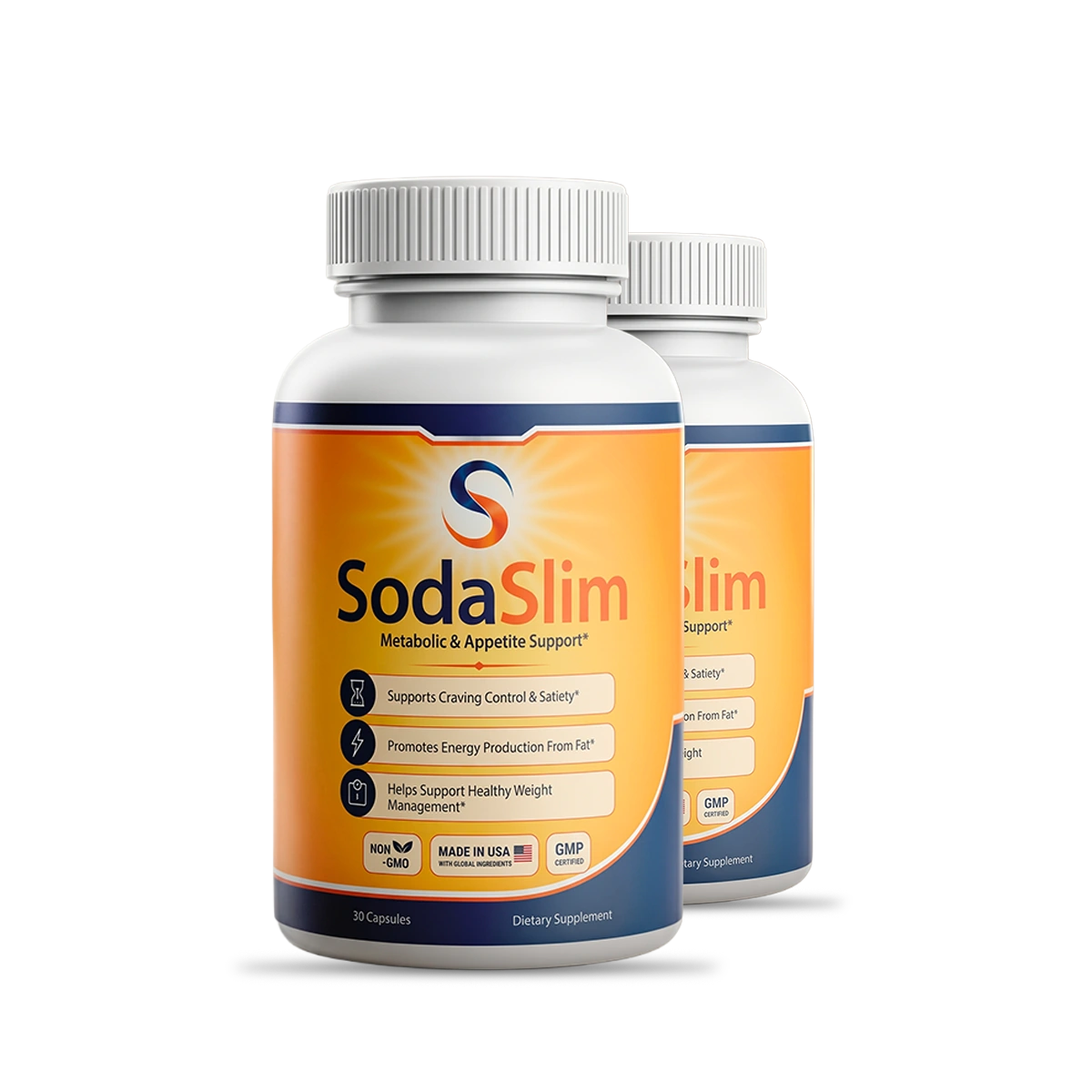
Run this method on SodaSlim before you buy it
It names five ingredients, prints no amounts, leads with a stimulant, and gives you sixty days from purchase to decide.
Two bottles $158 · six bottles $294 · 60-day money-back guarantee
Order SodaSlim On The Official WebsiteOne capsule a day · 30 per bottle · lot SOD-26/SO-3114