SodaSlim Official Website › Blog › How Long Does A Metabolism Capsule Take
How Long Does A Metabolism Capsule Take To Do Anything?
Day one is the stimulant. Everything else takes weeks.
Caffeine acts within the hour and its subjective effect fades as tolerance builds. The botanical trials in this category ran eight to twelve weeks, and buyer reports cluster at three to six. Those are different questions with different right answers.
Day one, and why it misleads
Take a capsule with caffeine in it and something happens within the hour. Caffeine is absorbed quickly and peaks in the blood at roughly thirty to sixty minutes, and the alertness that follows is unmistakable.
That immediacy is the most misleading thing about this entire category. It creates a strong impression on day one, which the buyer naturally attributes to the product as a whole, and it is the part of the effect least related to anything the product is actually sold for.
The measurable metabolic part is real but quiet. the 1989 thermogenesis study gave 100 mg of caffeine every two hours for twelve hours and measured a rise in both metabolic rate and daily energy expenditure. It is a change of a few per cent, invisible to the person having it.
What tolerance does to the first fortnight
Caffeine tolerance develops within days to weeks, and it develops unevenly. The subjective alertness fades fastest, which is why the third coffee of a regular drinker's day does far less than the first coffee of an occasional one's.
The thermogenic component appears to persist better than the subjective one, though the literature on that is less clean than anybody would like. The practical consequence is straightforward: week one feels like the strongest week and is not the week to judge anything on.
This is also where a great many people stop. A capsule that felt dramatic on Monday and ordinary by the following Friday reads as a product that stopped working, when what has happened is that the loudest and least relevant part of its effect has habituated.

What the trials actually measured, and when
The botanical evidence in this category runs on a completely different clock from the stimulant one, and reading the trial lengths makes that obvious.
| Trial | Length | Dose used | What it measured |
|---|---|---|---|
| The 1999 green tea extract study | 24-hour measurement | 90 mg EGCG and 50 mg caffeine, three times daily | 24-hour energy expenditure and fat oxidation |
| The 2008 green tea trial | 12 weeks | 400 mg extract three times daily | Weight and waist in obese women |
| The 2016 high-dose trial | 12 weeks | 856.8 mg EGCG daily | Weight, waist and lipid measures |
| The green coffee trial | 8 weeks | 400 mg decaffeinated extract twice daily | Anthropometry, glucose, appetite |
| The hydroxycitric acid satiety work | 2 weeks | 500 mg three times daily | Satiety, fat oxidation, energy expenditure |
| The 1998 garcinia trial | 12 weeks | 1,500 mg HCA daily | Fat mass, against placebo, and found no difference |
Doses are the amounts those trials used. A label that prints no amount cannot be compared with any of them.
Twelve weeks is the standard, eight is the short end, and the only two-week entry in that table measured satiety rather than weight. Nothing in this literature operates on a one-week timescale, which means nothing observed in week one can be attributed to the botanical half of any formula.
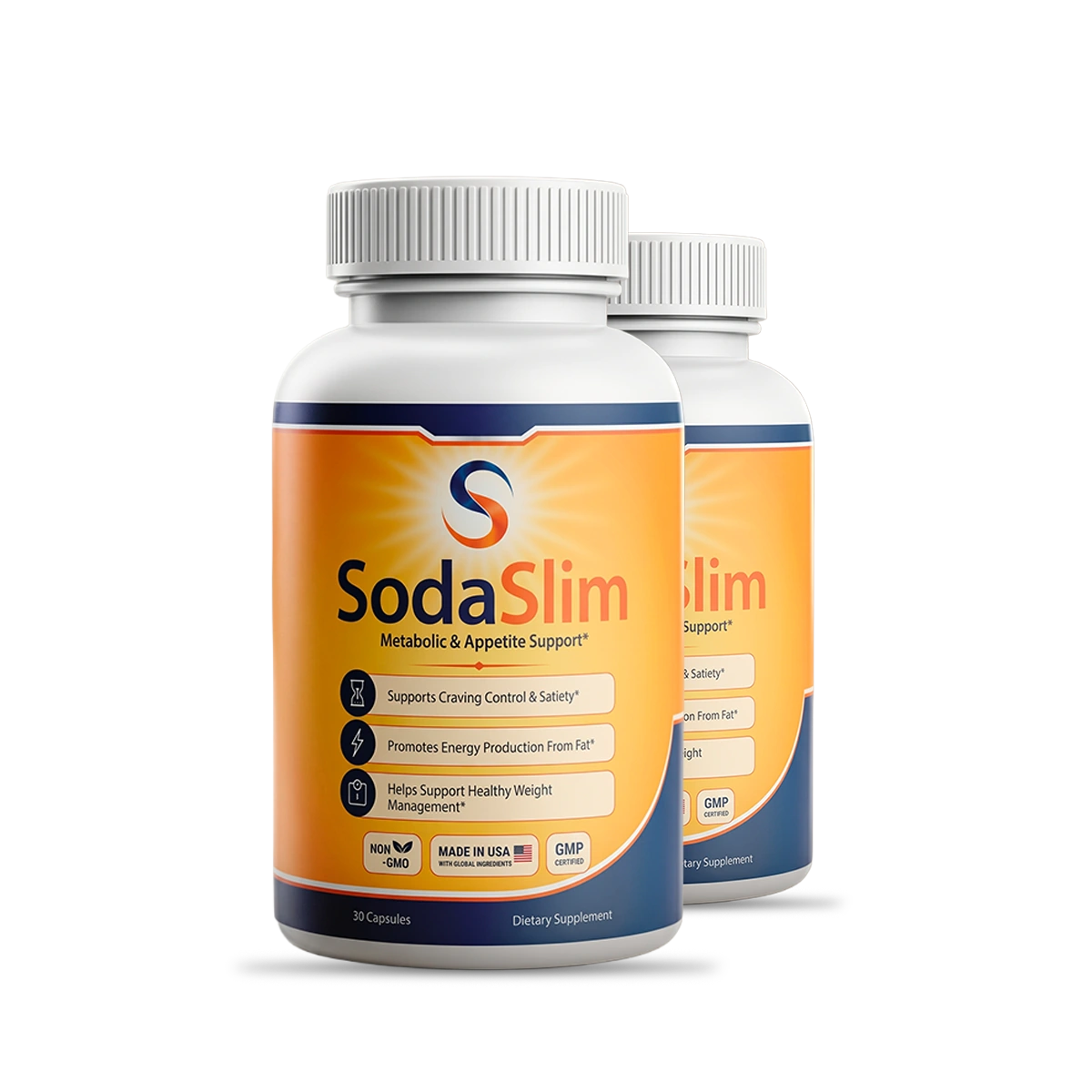
SodaSlim, while you are reading about it
Thirty capsules to the bottle, one of them each morning. Five botanicals are named on the front, and the window to change your mind runs sixty days from purchase.
Two bottles $158 · six bottles $294 · 60-day money-back guarantee
Order SodaSlim On The Official WebsiteOne capsule a day · 30 per bottle · lot SOD-26/SO-3114
What buyers report, and when
Buyer feedback on this product clusters at 3–6 weeks before anything is noticed, with appetite between meals the first thing mentioned. That is the seller's own summary of its own customers rather than a measurement, and it is still informative.
Notice that it sits between the two clocks. Later than the stimulant, earlier than the trial endpoints. That is what you would expect from people noticing a change rather than measuring one: a noticeable difference arrives before a statistically detectable average difference does, because a person is looking for something obvious and a trial is looking for something small.
It also sits comfortably inside a sixty-day refund window, which is not a coincidence. A window shorter than the reported point of change would force a decision before the information arrives.
Why the two timelines disagree
A trial and a buyer are answering different questions and it is worth being precise about the difference.
A trial recruits a defined group, controls what they eat, gives a stated dose on a fixed schedule, and measures a pre-specified outcome at a pre-specified time. It is built to detect a small average effect across a population, and twelve weeks is how long that takes to do reliably.
A buyer takes an unstated amount once a day while everything else in their life carries on changing, and notices whatever becomes noticeable. That process is excellent at catching a stimulant on day one and very poor at catching a two per cent shift in energy expenditure over three months.
Neither number is the other one's answer, and a page quoting only one of them would be misleading in one direction or the other.
What to measure, and what to ignore
Two numbers, written down, beat any amount of impression.
- A hunger score out of ten, at the same hour each day. Four in the afternoon works for most people. This is the outcome the satiety trials measured and the one buyers notice first.
- Waist circumference, once a week, same morning, before eating. It was the measure that moved in the eight-week green coffee trial and it is far less noisy than daily weight.
- Optionally, a single energy score a day at a fixed time, because energy across the working day is half of what these products are sold for and is otherwise remembered badly.
- Ignore any single day on the scale. Daily weight moves two to three pounds on water alone. A weekly average is useful; Tuesday against Monday is noise.
- Ignore week-one alertness. It is the part that habituates and it tells you about caffeine rather than about the product.
- Ignore somebody else's timeline. Buyer figures are a distribution, not a schedule, and the loudest reports in any review set are the outliers at both ends.
Fitting the timeline to a refund window
A 60-day window and a thirty-day request from the seller produce an obvious schedule. Take it daily for thirty days while tracking the two numbers. Decide on day thirty. Act between day thirty-one and day forty-five. Keep the last fortnight as margin for a phone call, a parcel and a bank.
That schedule also exposes something about pack sizes. A six-month supply against a two-month window means four months that can never be returned, whatever the per-bottle saving looks like. A ninety-day pack is much closer to the shape of the promise.
The results timeline page sets the same schedule out week by week, and the guarantee page covers what the window does and does not include.
The part of the effect that is not the capsule
Every trial in the table above compared its ingredient against a placebo, and in several of them the placebo group also improved. That is not a trick or a sign of a flawed study; it is what happens when people start paying attention to something.
Buying a metabolism capsule is rarely the only thing that changes. Somebody who has just spent two hundred dollars on a two-month plan is also, usually, walking a little more, ordering slightly differently at lunch and weighing themselves for the first time in a year. All of that is real and none of it is in the capsule.
The honest way to handle it is not to dismiss it. If the purchase is what started the attention, the attention still counts. But it does mean a result arriving in the first fortnight is much more likely to be everything else than to be the botanicals, which is another reason to judge at thirty days rather than at seven.
It is also the reason to change one thing at a time. A capsule started in the same week as a new gym membership has made itself impossible to evaluate, and the refund window will close before anybody can work out which one did what.
When to decide it is not working
At six weeks, if both numbers are unchanged. That is past the reported point of change, past the first checkpoint of the shortest relevant trial, and still inside a sixty-day window.
Earlier than that if the capsule is causing a problem: persistent jitteriness, lost sleep, stomach upset that has not settled in a week. Tolerability is assessable immediately and there is no reason to spend six weeks on a product that is uncomfortable from the start.
And it is worth saying what a fair positive result looks like, because the expectations in this category are set by advertising rather than by evidence. A quieter afternoon, a slightly easier time between meals, and a waist measurement drifting gently in the right direction over two months alongside everything else you are doing. That is what the trials found, at doses they printed. It is not dramatic, and it is real.
- Dulloo AG, Geissler CA, Horton T, Collins A, Miller DS. Normal caffeine consumption: influence on thermogenesis and daily energy expenditure in lean and postobese human volunteers. Am J Clin Nutr. 1989;49(1):44-50. PMID 2912010. https://pubmed.ncbi.nlm.nih.gov/2912010/
- Dulloo AG, Duret C, Rohrer D, Girardier L, Mensi N, Fathi M, et al. Efficacy of a green tea extract rich in catechin polyphenols and caffeine in increasing 24-h energy expenditure and fat oxidation in humans. Am J Clin Nutr. 1999;70(6):1040-5. PMID 10584049. https://pubmed.ncbi.nlm.nih.gov/10584049/
- Hsu CH, Tsai TH, Kao YH, Hwang KC, Tseng TY, Chou P. Effect of green tea extract on obese women: a randomized, double-blind, placebo-controlled clinical trial. Clin Nutr. 2008;27(3):363-70. PMID 18468736. https://pubmed.ncbi.nlm.nih.gov/18468736/
- Chen IJ, Liu CY, Chiu JP, Hsu CH. Therapeutic effect of high-dose green tea extract on weight reduction: A randomized, double-blind, placebo-controlled clinical trial. Clin Nutr. 2016;35(3):592-9. PMID 26093535. https://pubmed.ncbi.nlm.nih.gov/26093535/
- Roshan H, Nikpayam O, Sedaghat M, Sohrab G. Effects of green coffee extract supplementation on anthropometric indices, glycaemic control, blood pressure, lipid profile, insulin resistance and appetite in patients with the metabolic syndrome: a randomised clinical trial. Br J Nutr. 2018;119(3):250-258. PMID 29307310. https://pubmed.ncbi.nlm.nih.gov/29307310/
- Kovacs EM, Westerterp-Plantenga MS, Saris WH. The effects of 2-week ingestion of (--)-hydroxycitrate and (--)-hydroxycitrate combined with medium-chain triglycerides on satiety, fat oxidation, energy expenditure and body weight. Int J Obes Relat Metab Disord. 2001;25(7):1087-94. PMID 11443511. https://pubmed.ncbi.nlm.nih.gov/11443511/
- Heymsfield SB, Allison DB, Vasselli JR, Pietrobelli A, Greenfield D, Nunez C. Garcinia cambogia (hydroxycitric acid) as a potential antiobesity agent: a randomized controlled trial. JAMA. 1998;280(18):1596-600. PMID 9820262. https://pubmed.ncbi.nlm.nih.gov/9820262/